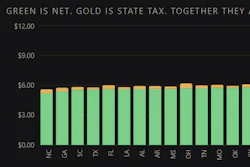












As a brutal three-year freight rates slump clears up and spot market rates bounce around all-time highs, just how much gets eaten up in the gap between shipper spend and what owner-operators take home, also known as broker margins?
Overdrive readers have long fretted over margins, with 2024 polling showing 67% didn't trust spot rate averages and 73% supported broker transparency enforcement to enable owner-ops to see the margins themselves.
[Related: Broker margins, rates data, transparency: What owner-operators really think]
Brokers, both in media and in audited financial statements, have long claimed averaging 13%-15% gross margins, or what they keep between the shipper spend and the carrier's pay. A few high profile instances when broker transparency has been revealed, however, showed much higher margins on individual loads (44% for TQL, almost 80% at a previous version of Convoy).
Former DAT Chief of Analytics Ken Adamo's "fat rips and fat lips" index provided the best source of data on broker margins, yet DAT no longer produces any such report. Overdrive tracked down Adamo and Truckstop.com VP of Corporate Strategy Sean Dehan to get a read on just how much brokers are pocketing from spot freight.
First, a bit of a rates update: As per DAT's latest this week, van rates sat at national average $3.02/mile, reefer rates at $3.39, and flatbed at a towering $3.72/mile.
After years of struggling around the $2 mark, similar numbers tracked by Truckstop.com and FTR Transportation Intelligence have set records and caught eyeballs, but it's not all what it seems, according to Dehan.
"What we’re tracking pretty closely is that if you look at the whole market very holistically, we looked at real rates before fuel on the spot side, and almost all the equipment types remain below what would have been a trend line from 2020," he said.
In other words, "on an inflation-adjusted basis, most of our carriers are still not making the same money as before the pandemic."
While a flatbed hauler may pull in $4/mile just like in the pandemic-era boom time, inflation, mostly insurance and fuel, has gone way up since then. Four dollars in 2021 just went a lot further than $4 in 2026.
A recent report from JBF Consulting said truckload breakeven price per mile hit $3.12 as of Q2 2026, crossing the $3 threshold for the first time in history. "Trucking costs are up about 30%" said Dehan.
Obviously, carrier profit margins have taken big hits over the last five years, but what about brokers?
[Related: Owner-operator revenue down again, but income's finaly rising]
Broker margins: Did they rise with spot rates?
Adamo previously calculated broker margins by looking at shipper spend data and comparing that to the prices at which brokers bought trucking capacity.
These days, Dehan said "margins are challenged right now for brokers and have been for the last six months or so as rates have moved up quickly and meaningfully."
These have hit bigger brokers who have recently moved into "asset-like" models where they sell contracts to shippers much like a carrier would, then pick the trucks up off the spot market, Dehan said.
When spot rates shift quickly, those big brokers with contracts can get hammered by ever-more-expensive owner-operators in spot negotiations.
[Related: Resist freight-rates capitulation in today's go-go-go spot markets]
Is that the case with Adamo's new Ease Logistics gig as Chief Strategy Officer?
"Regarding broker margins, it really is a tale of two sides of the business," he said.
Since bigger brokers now lock in contracts and most smaller brokers only ever get access to spot loads from shippers, smaller brokers might be doing well while bigger, contract-holding brokers get whacked.
"Nearly all the big brokers I know of, Ease being one of them, strategically try to balance spot and contract depending on market cycle," said Adamo.
While Ease is taking in a lot of cash on the new, higher-dollar-figure transactions, the actual margin percentage has stayed pretty flat.
"Gross margin per load on spot loads are up 40%-45% since last June even" in dollar amounts, "though the gross margin percentage is within .2% of last year," said Adamo. "Part of this is strategic, as we try to stay somewhat steady on spot freight markup as underlying cost moves around."
As for contracted freight at Ease, while revenue per load is still up in dollar amounts, the percentage has gotten squeezed considerably. With contract terms typically annual, part of the problem is just bad timing.
"Most of these contracts were either awarded or renewed in the last six to nine months and margins have totally collapsed," said Adamo. "The decreased percentage margins are considerably outweighing the increased revenue per load."
Sean Dehan said the type of large brokers who hold contracts prioritize keeping customers happy, and would rarely negotiate. Still, the breaking point fast approaches at these rates.
"Large brokers don’t want to lose marketshare," said Dehan. "They want to grow in all markets, whether they're good or bad, they want to grow volumes, that's a key part of their game So larger brokers tend to be slower to go to shipper customers with rate conversations -- they just don’t want to lose the loads."
In the competitive brokerage world, raising prices can quickly lose you a customer, so contracts only get reworked when brokers really feel the pain. That might be happening now, Adamo said.
"Many shippers are undergoing repricing efforts with their providers, both asset and non-asset carriers," he said. "This is true for awards as recent as late Q1 or early Q2 of this year. The thinking here is that routing guides must be fortified heading into what most expect to be a very rocky peak season this fall."
Looking at the market generally, Adamo said brokers who are not looking to grow marketshare "are likely pushing 18%+" margins. But for brokers who are willing to bite the bullet, margins are likely much lower but leading to bigger-volume relationships.
"If your goal is to gain marketshare, I suspect that spot margins are hovering in the 10%-12% range and you’re gobbling up contract freight that everyone else is rejecting," said Adamo.
Finally, on the topic of Adamo becoming a broker after years as one of top voices in freight data on broker margins, he made a joke about some of the trucking activists he'd frequently spar with.
"It’s been good to confirm my hypothesis that I had while at DAT that brokers aren’t averaging 65% margins," Adamo said.
[Related: FMCSA investigates TQL as fight over broker transparency rages]
By the way, the Federal Motor Carrier Safety Administration was supposed to release an updated broker transparency rule in May, but hasn't yet. Overdrive has inquired about the rulemaking's status, so stay tuned for more updates.
Keep tuned, too, for results from our recent survey probing transparency, broker credit checks and other vetting. The early word? Asked about broker transparency, more than half of respondents strongly favored of the FMCSA's late-2024 proposal, yet a third of respondents gave this view:
Regulators should move faster to finalize the proposal and get it across the finish line.