











As the door slams in the face of non-citizen drivers across the country, non-domiciled CDL holders and advocacy groups are calling on California and Pennsylvania to defy federal authorities.
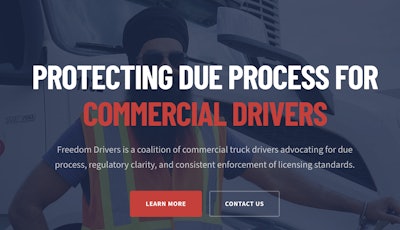
Freedom Drivers, a California-based alliance of immigrant truck drivers, on Thursday called for "immediate action as thousands of CDLs are set to expire March 6."
In Pennsylvania, another coalition pressed state transportation officials to keep non-domiciled CDLs in play.
California in November notified about 17,000 non-domiciled CDL holders their licenses had been improperly issued and would soon expire, after a good bit of prodding from the U.S. Department of Transportation. In December, California tried to reverse that decision, but DOT stopped them right around Christmas.
DOT has threatened to withhold up to $160 million in federal highway funding for the state if it doesn't comply with revoking all improperly issued non-domiciled CDLs.
California sued DOT over its threats to withhold funding from the state because it refused for almost a year to enforce English language proficiency at roadside. California, in turn, was sued by the Sikh Coalition when it sent out those letters about the 17,000 CDLs being revoked.
[Related: California capitulation: CHP finally enforcing English language proficiency roadside]
With California stuck between a rock and a hard place -- risking $160 million and potentially the decertification of its CDL program if it crosses DOT, and facing a lawsuit and accusations of discrimination and capitulation if it doesn't defy DOT and keep the non-domiciled CDLs flowing -- the Freedom Drivers group demands the latter.
The group said revoking the CDLs in California could "sideline lawful drivers and destabilize an industry."
Freedom Drivers brought out the old "driver shortage" narrative in defense of their claims that revoking non-domiciled CDLs would make "freight shipments slow due to the loss of experienced drivers."
DOT, for the most part, has poured cold water on that narrative, pushed for many years by the American Trucking Associations. In fact, in announcing DOT's September rulemaking effort to end non-domiciled CDLs, Secretary Sean Duffy addressed the driver shortage notion head on, saying he's not worried.
[Related: Did DOT Secretary Duffy just kill trucking's 'driver shortage' narrative once and for all?]
"For an independent trucker, it's devastating," said Fateh Singh of the curtailment of non-domiciled CDL issuance. Singh is an owner-operator and a cofounder of Freedom Drivers. "This isn't just a job -- it's how I feed my family. If my CDL expires, the income stops immediately, but my truck payment and bills don't. Losing my CDL can erase years of hard work overnight."
Overdrive spoke to Singh, who said he's been in the country 13 years and driving commercially for almost five. Singh's a one-truck owner-op who mostly works with brokers.
Though Singh had an extensive driving history in the U.S. before getting his CDL, his California CDL application did not ask him for his Motor Vehicle Record, something U.S. citizens must provide.
FMCSA in its February Final Rule said that it needed to ban non-domiciled CDLs for all but a few small categories of business visa holders because it had "identified an unacceptable bifurcated standard in driver vetting" that required domestic CDL applicants to "face rigorous driver history checks through the Commercial Driver’s License Information System (CDLIS) and the Problem Driver Pointer System (PDPS)," but that did not similarly require a check of driving history of non-domiciled applicants.
Still, Singh said California should stand up for the "fundamental rights" of the 17,000 non-citizen drivers facing a loss of their CDL on March 6 -- even if it costs California $160 million and its ability to issue CDLs.
"They're killing us," he said, mentioning his $3,000 truck payment for a rig he'd otherwise have fully paid off next year.
With two kids at home, Singh said after March 6 he'll be looking at selling the truck or facing bankruptcy if nothing changes.
"I passed the same written exam [in English], road test, and federally required English standards as anyone else," he said. "I carry the same CDL and insurance. This isn't about special treatment -- it's about equal treatment."
[Related: Meet the owner-op who stopped FMCSA's non-domiciled CDL purge]
Separately, the Pennsylvania Immigration Coalition wrote a letter to Michael Carroll, Secretary of Transportation at PennDOT urging him to keep non-domiciled CDLs in play.
PIC expressed "serious concern regarding PennDOT’s reported decision to halt the renewal and reissuance of non-domiciled Commercial Driver’s Licenses (CDLs); a move that threatens the livelihoods of approximately 12,000 immigrant truck drivers in Pennsylvania and that exacerbates an already severe workforce shortage."
PIC also leans heavily on the "driver shortage" notion, saying PennDOT suspending issuance of non-domiciled CDLs, something nearly every state in the union has done since September, is "voluntary compliance with a coercive federal strategy."
Pennsylvania has frequently sparred with DOT, once notably over the issuance of a CDL to a "wanted terrorist" driver that the state says the federal government greenlit for his credential.
As with California, Pennsylvania was put under special orders from DOT to pause non-domiciled CDL issuance or lose federal funding. That took place in November, and DOT gave Pennsylvania 30 days to come into compliance.
Now months later, PennDOT has argued that it is in compliance and would like to continue issuing non-domiciled CDLs. DOT hasn't been responsive to those requests, and instead in the intervening months issued another Final Rule proposing to ban non-domiciled CDLs. That rule has already been challenged in court, but it should take effect on March 13 assuming no further court action.
Like California, Pennsylvania finds itself between a rock and a hard place. Should the state start back up its non-domiciled CDL program in defiance of federal law and risk $75 million in funding, only to likely have to shut down issuance in less than 30 days? Or stand accused by immigration advocates of abandoning "its own workforce and economic interests under federal pressure rather than defend them."
On Wednesday, the state of Illinois, similarly accused of non-domiciled CDL missteps by DOT and threatened with $128M worth in federal funding, also defended the role of non-citizen drivers in trucking and the economy.
[Related: Illinois defends non-domiciled CDLs after DOT threatens 128M penalty]