A federal judge on Thursday afternoon granted a temporary restraining order (TRO) that blocks the Department of Transportation from obtaining more than 17 million CDL holder records while a case calling for a preliminary injunction blocking the request altogether is considered.
The case pits 21 states and D.C. against the U.S. DOT and the Federal Motor Carrier Safety Administration. As reported Thursday, both sides made their cases in court filings this week for and against the temporary restraining order.
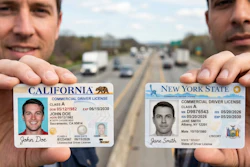
The case stems from requests from DOT/FMCSA and the Department of Homeland Security for the American Association of Motor Vehicle Administrators (AAMVA) to turn over the entire Commercial Driver’s License Information System (CDLIS) database for the purposes of investigating "illegal practices" in CDL schools, according to the original lawsuit. Agencies also noted intent to ID and address "criminal fraud regarding the issuance of CDLs to illegal aliens, and conducting civil immigration enforcement."
Senior U.S. District Judge Anthony J. Trenga for the Eastern District of Virginia sided with the states and granted the TRO. Trenga’s ruling weighed heavily in favor of the states’ arguments, dealing a blow to the government’s chances of obtaining the full database.
[Related: FMCSA, states trade blows over feds' access to 17M CDL records]
Trenga’s order noted that, in order to obtain a TRO, a plaintiff must show:
- Likelihood of success on merits
- Irreparable harm in the absence of injunctive relief
- That the balance of equities tip in the plaintiff’s favor
- That the issuance of preliminary injunctive relief is in the public interest
Trenga also pointed out that the “standard for granting either a TRO or a preliminary injunction,” the latter of which is what the court will ultimately decide on, “is the same.”
Judge Trenga highlighted FMCSA’s own policy that “explicitly states that ‘the records in CDLIS are not controlled by FMCSA,’” and that the records in the CDLIS “belong to the states, not the federal government,” Trenga said.
The judge then went on to effectively dismantle FMCSA’s argument against granting the TRO.
Court does have jurisdiction. That's contrary to FMCSA's claims made in prior filings. Trenga said “FMCSA’s unequivocal demand that the AAMVA turn over 17 million records constitutes ‘final agency action.’”
States likely to succeed in wider case. The court concluded that states' case is “likely to succeed on the merits of their [Administrative Procedure Act] claims that the FMCSA's demand for the wholesale transfer of the CDLIS database, and threatened sanctions, violates the [Commercial Motor Vehicle Safety Act] and is contrary to the [Driver's Privacy Protection Act] and the Privacy Act.”
The states were also found to be likely to succeed on their claims that the federal government’s data demand “is arbitrary and capricious,” and that the demand violations the Constitution’s Spending Clause, which requires that any condition on federal funding be imposed through "clear notice" of the condition it intended to impose.
[Related: DOT makes it official: California loses $160M over non-domiciled CDL battle]
Large-scale CDL records disclosure = irreparable harm. Judge Trenga found that states “made a clear showing of irreparable harm in the absence of injunctive relief. Courts have often found that the unauthorized disclosures of information provided to agencies, particularly those involving a large-scale disclosure of sensitive information, constitute irreparable harm.”
Trenga added that FMCSA “has provided no confidentiality assurances and openly admits that it intends to share the records with DHS so that it can be used for immigration enforcement, among other things. Such large scale and unregulated distribution inevitably compromises and undermines the public's trust in the Plaintiff States' promises to safeguard its residents' personal information.”
As detailed in Thursday’s reporting, FMCSA argued that entering an injunction would go against the public interest because it would “disrupt [the federal government’s] efforts to ensure the integrity and issuance of CDLs and Commercial License Permits.”
Trenga said, however, that FMCSA has “been unable to explain how precisely the limited but highly sensitive personal information would assist them in that regard. This contention is also hard to square with the fact that the FMCSA has fulfilled its statutory obligations for decades without the demanded transfer of data.”
With these conclusions, Trenga granted the states’ motion for a TRO, pending the court’s consideration and ruling on the motion for a preliminary injunction.
Until that time, AAMVA is enjoined from transferring the requested CDLIS data to FMCSA or any other agency, and FMCSA is enjoined from taking any adverse actions against the states or AAMVA.
For next steps in the case, the states have been directed to file any motion for a preliminary injunction on or before Aug. 27, and the federal government is given until Sept. 3 to respond to the motion. The next court hearing will be held on Sept. 10.
A separate case from 22 states and D.C. against DHS over the same matters is currently on hold while the DOT case plays out.
[Related: States sue DOT, DHS over demands for drivers' CDLIS records]