










Trucking news and briefs for Friday, Aug. 21, 2026:
- More legislation aimed at non-domiciled CDL issuance.
- Interstate closure planned in Pacific Northwest.
- State touts big savings from online truck permitting system.
New bill would require FMCSA to audit states’ non-domiciled CDLs
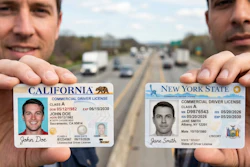
U.S. Rep. Harriet Hageman (R-Wyoming) this week introduced legislation to require federal regulators to audit states issuing non-domiciled commercial driver’s licenses to “illegal aliens and unqualified drivers,” according to a press release from Hageman’s office.
While text of the newly introduced “Strengthening Transportation Oversight and Preventing (STOP) Improper Licensing Act” was not immediately available, Hageman said her bill would:
- Require the Federal Motor Carrier Safety Administration to review a random sample of non-domiciled CDLs in every state, something the Trump administration has already pursued in many over the last year
- Target non-domiciled CDLs issued without checking legal status and those that stayed active after that status expired
- Require the findings to be published and reported to Congress
- Give failing states 60 days to fix the problem, with repeat audits for the worst offenders
- Cut off all FMCSA funding to any state that refuses to comply
[Related: Trump's FMCSA effectively ends non-domiciled CDLs]
"Wyoming truckers earn every credential they carry,” Hageman said in introducing the bill. “They train, test, and follow the law. Other states hand out CDLs to illegal aliens, and families pay for that failure with their lives. My bill requires regulators to review the books and clean up America’s highways after years of unchecked immigration flooded the nation with thousands of unqualified drivers.”
The Trump administration's FMCSA this year fully enshrined a rule effectively banning non-domiciled CDL issuance to work-authorized non-citizens outside a narrow class of visa holders. Yet non-domiciled drivers' court challenge could see big action as early as next month.
As described, Hageman's legislation seems designed to enshrine closer scrutiny of the non-citizen commercial credential moving ahead, and several trucking associations, including the Owner-Operator Independent Drivers Association, American Trucking Associations and Truckload Carriers Association, voiced support.
“Rep. Hageman has shown a strong commitment to improving safety in trucking few other lawmakers can match,” said OOIDA President Todd Spencer. “She has consistently championed sensible solutions to some of the biggest problems facing our industry. The STOP Improper Licensing Act, which will help identify and address compliance lapses in the issuance of non-domiciled CDLs, is the latest example of her extraordinary commitment to improving highway safety.”
Hageman said that with the recent FMCSA rule significantly reducing the size of the category of foreign worker who is eligible for a non-domiciled CDL in the United States, this new bill “is necessary to ensure continued oversight and compliance.”
[Related: Court blocks DOT's demand for CDL records, siding with states]
The bill was introduced in the U.S. House on Aug. 20 and referred to the Committee on Transportation and Infrastructure.
Her bill isn’t the first introduced this year to address non-domiciled CDLs. Others also introduced this year would require FMCSA to establish and maintain a database of non-domiciled CDLs, and restrict non-domiciled CDLs to U.S. citizens or green card holders.
Hageman spearheaded a number of other trucking-related bills of late, including legislation aimed at rooting out chameleon carriers, codifying FMCSA's English language proficiency requirement into law, and putting a mileage limit on under-21 truck drivers rather than stopping them at state lines.
[Related: How non-domiciled drivers will try to get FMCSA's CDL ban thrown out]
I-205 closure planned overnight Saturday
The southbound lanes of Interstate 205 across the Abernethy Bridge near Portland, Oregon, will close overnight Saturday as part of construction work on the bridge.
Construction crews will close SB lanes of the bridge from 11 p.m. Saturday, Aug. 22, to 7 a.m. Sunday, Aug. 23, to pour concrete on the newly widened bridge deck.
The closure will be between Oregon Highway 99E and Oregon Highway 43. The OR 99E on-ramp to SB I-205 will also be closed for the work from 10 p.m. to 8 a.m.
NB interstate lanes will remain open.
SB traffic can bypass I-205 in this section by using detours on I-5, I-84 and the Ross Island Bridge. Local traffic can use the Arch Bridge to cross the river.
Oregon's self-serve permitting system in focus after year 1
A new web-based, self-service permitting system for motor carriers moving over-dimension loads through Oregon has created $940,000 in savings in its first year of operation, the state announced this week.
The Oregon Routing Information Online project, better known as ORION, went live in May 2025.
A typical truck-tractor scales in at about 9 feet wide, 13' tall and 70' long. Over-dimensional loads can hit 12 to 16 wide and reach heights of 18 feet or more. Superloads might exceed 150 feet in length, with weights upward of 250,000 lbs. Any vehicle that exceeds legal vehicle dimensions and weight needs a permit.
Said ODOT Commerce and Compliance Administrator Carla Phelps, “Ensuring these over-dimension loads can travel through the state without incident is critical to the safety of the traveling public, commercial drivers, and Oregon roads and bridges.”
Before ORION went live last year, the permit process was labor-intensive and time-consuming, ODOT noted. Permit analysts used paper maps and attachments for guidance on which routes were best depending on the weight, width, length and height of the load. An electronic routing manual was used to verify vertical clearances, weight restrictions and temporary restrictions along each state highway.
The move to online permitting has been something of a national trend, but occurring on differing timelines in each state jurisdiction. Famously, there is no national system, and likely never will be.
[Related: Heavy/oversize permitting: Will there ever be a truly national system?]
Oregon's new ORION system effectively programs all information into it, regularly updated as changes occur. Carriers with an active registration/tax account there can thus enter vehicle dimensions and other information, and their start and end points, which ORION analyzes and details the shortest, safest route.
Some load or route criteria remain that, when triggered, require additional review and approval from analysts and road authorities. Yet the process has been greatly automated, sending emails to the road authorities, letting them know they have a permit to review in ORION.
“ORION has allowed our staff to shift their focus to the largest and more complex loads that require extensive coordination and careful safety review,” said Phelps. “This modernization project eliminated the need to fill seven currently vacant positions, which helped fill the budget gap left by a struggling State Highway Fund.”
Some benefits from the first year of ORION include:
- 45% of single-trip permits are now self-issued by customers on the spot
- Call volume has decreased by nearly 50%
- Customer wait times have been reduced by more than 80%
- A significant decrease in paper-centric processes; permits are now stored and retrieved electronically.
- Automatic updates to TripCheck, giving carriers immediate access to current conditions and improving roadway safety.